

You have heard that Chinese herbs can help with fertility. Maybe a friend in Singapore swore by the herbal brews her sinseh prescribed before she conceived. Maybe you spotted “fertility tea” on Shopee and wondered if that counts. This guide is about the herbs and formulas a physician might prescribe, not a clinic overview, and not a DIY shopping list from Shopee.
TCM physicians in Singapore do not hand out a generic “fertility herb.” They prescribe customised formulations based on your diagnostic pattern. Two women struggling to conceive may receive entirely different prescriptions because the underlying imbalance is different. That specificity is the point. For the full fertility programme (assessment, acupuncture, and lifestyle support alongside herbs), see our TCM natural fertility service.
How TCM Herbal Prescriptions for Fertility Actually Work
Herbal prescriptions follow pattern differentiation, not a single “infertility” label. The physician identifies the pattern driving the difficulty, then chooses herbs that correct it. Common fertility-related patterns include Kidney Yang deficiency, Kidney Yin deficiency, Blood stasis, Liver Qi stagnation, Spleen Qi deficiency, and Phlegm-Damp accumulation.
Each pattern has distinct symptoms and requires a different herbal strategy. A woman with cold hands, low basal body temperature, and a long luteal phase likely has Kidney Yang deficiency. A woman with night sweats, scanty cervical mucus, and a short follicular phase may have Kidney Yin deficiency. The herbs prescribed for one would be wrong for the other.
A systematic review and meta-analysis published in the Journal of Ethnopharmacology analysed studies on herbal therapeutics for female infertility and found that herbal formulations showed promising outcomes when prescribed according to pattern differentiation, the diagnostic backbone of TCM practice.
Commonly Prescribed TCM Herbs for Fertility
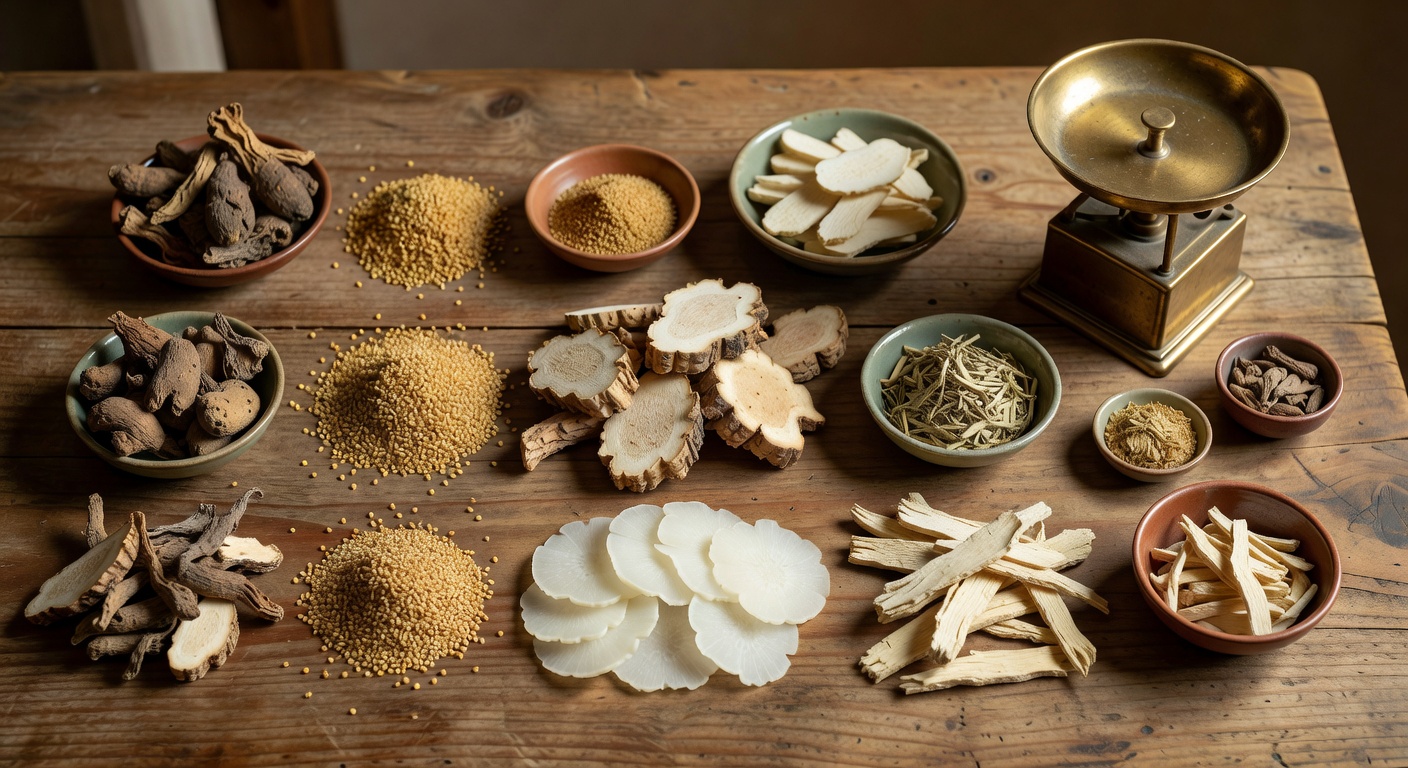
These are herbs you are likely to encounter in your prescription. None of these should be self-prescribed. They are listed here so you understand what your physician is doing and why, not so you can build your own formula from the Chinese medicine hall downstairs.
Kidney-Tonifying Herbs
In TCM theory, the Kidney system governs reproduction, stores Jing (essence), and controls the quality of eggs and the strength of the uterine environment. Most fertility prescriptions include at least one Kidney tonic.
Shu Di Huang (熟地黄) / Prepared Rehmannia Root: This is the heavyweight Kidney Yin and Blood tonic. Dark, sticky, and dense, Shu Di Huang nourishes the Kidney essence that supports egg quality and endometrial thickness. It appears in classical formulas like Liu Wei Di Huang Wan (Six-Ingredient Rehmannia Pill) and is one of the most frequently prescribed fertility herbs across TCM practice. Your TCM physician may pair it with herbs that aid digestion, as Shu Di Huang can be heavy on the Spleen.
Tu Si Zi (菟丝子) / Chinese Dodder Seed: A Kidney Yang and Yin tonic that supports both warming and nourishing functions. Tu Si Zi is valued for its gentle nature. It strengthens Kidney Qi without being overly heating, making it suitable for women who have mixed deficiency patterns. Classical texts describe it as “securing the pregnancy,” and it frequently appears in formulas aimed at both conception and early pregnancy support.
Du Zhong (杜仲) / Eucommia Bark: Primarily a Kidney Yang tonic that also strengthens the lower back and stabilises the Chong and Ren meridians, the two extraordinary vessels most directly linked to reproductive function. Du Zhong is commonly prescribed for women with lower back pain, a history of threatened miscarriage, or Kidney Yang deficiency patterns.
Xu Duan (续断) / Dipsacus Root: The name literally translates to “restore what is broken.” Xu Duan tonifies the Kidney and Liver, strengthens sinews and bones, and is traditionally used to support pregnancy. It is often paired with Du Zhong in prescriptions for women with a history of pregnancy loss.
Blood-Nourishing and Circulation Herbs
Healthy blood flow to the uterus and ovaries matters. TCM conceptualises this through Blood nourishment and Blood movement. Stagnant Blood or insufficient Blood both create problems for conception.
Dang Gui (当归) / Chinese Angelica Root: Often called the “female ginseng,” Dang Gui is the most iconic Blood-nourishing herb in the TCM pharmacopoeia. It tonifies Blood, promotes circulation, and regulates menstruation. Different parts of the root serve different purposes: the head (Gui Tou) stops bleeding, the body (Gui Shen) nourishes Blood, and the tail (Gui Wei) invigorates Blood. Your physician selects the part based on your specific pattern.
Bai Shao (白芍) / White Peony Root: Nourishes Blood and preserves Yin while softening the Liver. Bai Shao is frequently combined with Dang Gui in the classic pairing known as “Si Wu Tang base” to address Blood deficiency presenting as scanty periods, pale complexion, and dizziness. For fertility, adequate Blood levels are essential for building a receptive endometrial lining.
Dan Shen (丹参) / Salvia Root: An important Blood-invigorating herb that promotes circulation without being overly draining. Dan Shen is particularly useful for women with Blood stasis patterns, such as painful periods with dark clots, or those with a history of endometriosis. It helps improve blood flow to the reproductive organs.
Qi-Regulating and Spleen-Supporting Herbs
Qi is the engine that moves Blood and transforms nutrients. A woman with strong Blood but weak Qi will still struggle, because the body lacks the energy to drive reproductive processes. Spleen Qi specifically governs digestion and the transformation of food into usable resources.
Huang Qi (黄芪) / Astragalus Root: A premier Qi tonic that strengthens the Spleen and raises Yang energy. Huang Qi supports immune function, improves energy levels, and helps the body absorb and utilise nutrients from food and other herbs. In fertility prescriptions, it often serves as the “engine” that powers the formula’s other ingredients.
Bai Zhu (白术) / White Atractylodes: Strengthens the Spleen and dries Dampness. For women who experience bloating, loose stools, fatigue after eating, or excessive vaginal discharge, Bai Zhu addresses the underlying Spleen weakness. A well-functioning Spleen is essential for generating the Blood and Qi needed to sustain a pregnancy.
Xiang Fu (香附) / Cyperus Rhizome: Known as the “commander of Qi,” Xiang Fu is the go-to herb for Liver Qi stagnation affecting the reproductive system. It regulates Qi flow, eases menstrual pain, and smooths emotional tension. Women who feel their cycles are affected by stress often benefit from formulas containing Xiang Fu.
Phlegm and Dampness-Resolving Herbs
Phlegm-Damp accumulation is the TCM pattern most commonly associated with PCOS, obesity-related infertility, and conditions where thick, sticky pathological substances block the reproductive pathways.
Cang Zhu (苍术) / Atractylodes Rhizome: A powerful Dampness-drying herb that is stronger and more aromatic than its cousin Bai Zhu. Cang Zhu is prescribed when Phlegm-Damp is a dominant pattern, often seen alongside irregular or absent periods, excessive weight gain, and heavy vaginal discharge.
Ban Xia (半夏) / Pinellia Tuber: Transforms Phlegm and harmonises the Stomach. Ban Xia is a key ingredient in formulas targeting Phlegm obstruction in the reproductive system. It is always prescribed in processed form, as the raw herb is toxic. Your physician knows this, which is one more reason not to self-prescribe.
Classical Formulas Your Physician May Use as a Base
TCM physicians rarely prescribe single herbs. They use classical formulas, refined over centuries of clinical use, as a starting point and then modify them for your specific presentation. Here are formulas commonly adapted for fertility treatment:
You Gui Wan (右归丸): “Restore the Right Kidney Pill.” For Kidney Yang deficiency with cold signs, low BBT, long cycles, and fatigue. Warms the Kidney, nourishes essence, and supports the luteal phase.
Zuo Gui Wan (左归丸): “Restore the Left Kidney Pill.” For Kidney Yin deficiency with heat signs, night sweats, dry mouth, and a shortened follicular phase. Nourishes Kidney Yin and essence to support follicle development.
Gui Shao Di Huang Wan: A modification of Liu Wei Di Huang Wan with added Dang Gui and Bai Shao. Addresses combined Kidney Yin and Blood deficiency, common in women over 35 or those with diminished ovarian reserve.
Wen Jing Tang (温经汤): “Warm the Menses Decoction.” For mixed patterns involving both Blood stasis and deficiency-cold. Particularly useful for women with painful, clotted periods and underlying Yang deficiency. This formula simultaneously warms, nourishes, and moves Blood.
Cang Fu Dao Tan Tang (苍附导痰汤): Specifically targets Phlegm-Damp obstructing the uterus. Frequently used for women with PCOS-type presentations who have irregular or absent ovulation. Systematic reviews support its role as an adjuvant therapy for improving ovulation and pregnancy rates in anovulatory cases.
How Your Prescription Changes Through Your Cycle
One thing that surprises many women is that their herbal prescription is not static. A skilled TCM physician adjusts the formula according to the four phases of your menstrual cycle:
Menstrual phase (Day 1 to 5): Focus on promoting smooth Blood flow and ensuring complete shedding of the uterine lining. Herbs that invigorate Blood, like Dan Shen and Yi Mu Cao, take priority. Heavy tonics are temporarily reduced.
Follicular phase (Day 6 to 12): Focus shifts to nourishing Yin and Blood to support follicle growth and endometrial thickening. Shu Di Huang, Bai Shao, and Gou Qi Zi (wolfberry) feature prominently.
Ovulation phase (Day 13 to 15): Qi-moving and Blood-invigorating herbs promote the transformation from Yin to Yang phase. This is when herbs like Xiang Fu and Dang Gui help ensure smooth ovulation.
Luteal phase (Day 16 to 28): Kidney Yang tonics like Tu Si Zi, Du Zhong, and Xu Duan warm the uterus and support implantation. The goal is to maintain adequate warmth and progesterone-equivalent support through the two-week wait.
This cyclical approach is one of the strengths of TCM fertility treatment. Rather than a one-size-fits-all prescription, the medicine adapts to where your body is in its reproductive rhythm.

What to Expect When Taking Fertility Herbs
Let us be honest about the practical side. TCM herbal decoctions are not delicious. They are warm, often bitter, and sometimes smell like a forest floor after rain. Here is what the experience typically looks like in Singapore clinics:
Concentrated granules vs. raw herbs: Many clinics now offer concentrated herbal granules that dissolve in hot water, which are more convenient and easier to dose than traditional raw herb decoctions. Raw herbs require boiling at home for 30 to 45 minutes, but some physicians prefer them for complex fertility cases because the dosage can be more precisely customised. Your physician will recommend the form that suits your pattern and lifestyle.
Typical treatment duration: Most fertility herb protocols run for three to six menstrual cycles, though some women see cycle improvements within the first one to two months. The herbs are not a quick fix. They are rebuilding foundational resources like Kidney essence and Blood volume, which takes time. If you have been trying to conceive for over a year, expect the herbal treatment course to reflect that timeline.
Side effects and adjustments: Mild digestive changes are common when starting herbs, especially formulas heavy in Blood tonics like Shu Di Huang. Loose stools, mild bloating, or changes in appetite usually settle within the first week. If symptoms persist, your physician will adjust the formula. This is normal and expected, not a sign that the herbs are wrong for you.
Cost in Singapore: A typical fertility herbal prescription ranges from to per week for granules, depending on formula complexity and whether raw herbs or concentrated granules are used. Some clinics offer package pricing for three-month treatment courses.
Why Self-Prescribing Fertility Herbs Is a Bad Idea
Pre-packaged “fertility teas” on Shopee and Lazada look convenient, but self-prescribing without a TCM diagnosis is a bad idea, the wrong herb can worsen your pattern, delay real care, or create new imbalances.
First, pattern mismatch matters. Taking warming Yang tonics when your pattern is actually Yin deficiency with heat will intensify symptoms. Taking Blood-moving herbs during early pregnancy can be dangerous. Without proper diagnosis, you are guessing with medicinal substances.
Second, herb quality matters. TCM herbs in Singapore fall under the MOH regulatory framework for TCM practice. Registered TCM physicians source herbs from licensed suppliers subject to safety testing. What you buy on an e-commerce platform may not meet those standards.
Third, dosage and combination are everything. A single herb works differently depending on what it is paired with, how it is processed, and the dosage prescribed. Dang Gui nourishes Blood in moderate doses but can have Blood-moving effects at higher doses. Your physician calibrates these details based on your body, not a generic product label.
Combining Herbs With Other TCM Fertility Treatments
Herbs are usually one pillar of a broader TCM fertility programme that may also include acupuncture and lifestyle guidance. Full programme details live on the service page; this article stays on the herbal side.
If you are also undergoing IVF or IUI, tell both your TCM physician and your fertility specialist. Certain herbs need to be paused at specific stages of assisted reproduction, and a responsible physician will coordinate those transitions with your Western protocol.
What to Ask Your TCM Physician
When you sit down for your fertility consultation, come prepared with these questions:
- What is my TCM diagnostic pattern, and how does it relate to my difficulty conceiving,
- Which herbs are in my prescription, and what does each one do,
- Will my formula change across my menstrual cycle,
- How long should I expect to take herbs before seeing changes in my cycle,
- Are there any foods or supplements I should avoid while taking these herbs,
- Should I stop the herbs at any point during my cycle or if I suspect pregnancy,
A good physician will answer all of these clearly. If your physician cannot explain what they are prescribing and why, that is worth noting. You deserve to understand what you are putting into your body, especially when you are trying to create a new one.
When you are ready for a pattern-based herbal plan (not a generic fertility tea), book a TCM fertility consultation. Every prescription starts with understanding your body first.