


You wanted this pregnancy. You planned for it, hoped for it, maybe spent months or years working towards it. And now that it is finally here, you are spending most of your waking hours feeling like you are on a boat in rough seas. The name “morning sickness” is misleading. It does not care what time it is. It hits in the morning, at lunch, at 3am, and sometimes all three in the same day.
Up to 80% of pregnant women experience nausea and vomiting in the first trimester, according to the American College of Obstetricians and Gynecologists (ACOG). If you are looking for TCM morning sickness relief in Singapore, you are not alone. For most women, it peaks between weeks 8 and 12 and resolves by week 16. For some, it lasts longer. For a small percentage, it becomes hyperemesis gravidarum, a severe form requiring medical intervention. This guide is for the majority: women dealing with persistent, draining nausea that makes the first trimester feel more like endurance training than a celebration.
Why Morning Sickness Happens: The TCM Perspective
Western medicine attributes morning sickness primarily to rising hCG (human chorionic gonadotropin) levels and hormonal changes in early pregnancy. The exact mechanism is still debated, but the hormonal surge explanation covers the basics.
TCM offers a complementary framework. In TCM theory, pregnancy causes a significant shift in the body’s Qi and Blood dynamics. When conception occurs, the Chong meridian (one of the extraordinary vessels that governs the uterus) redirects Blood and Qi downward to nourish the developing embryo. This redirection can disrupt the normal downward flow of Stomach Qi, causing it to rebel upward. When Stomach Qi goes up instead of down, you get nausea, retching, and vomiting.
TCM calls this pattern “Chong Qi Fan Wei” (冲气犯胃), literally “the Chong Qi offending the Stomach.” It is not a disease. It is a physiological response to the body reorganising its resources for pregnancy. But the severity varies depending on your pre-existing constitution:
- Spleen Qi deficiency: Women who already had weak digestion, bloating, or fatigue before pregnancy tend to experience more severe nausea. The Spleen is responsible for transforming food and generating Qi, and when it is already struggling, the additional demands of pregnancy overwhelm it.
- Stomach Yin deficiency: Women with a tendency towards acid reflux, dry mouth, or a preference for cold drinks may have underlying Stomach Yin deficiency. The heat generated by pregnancy compounds this, leading to intense nausea with a burning quality and difficulty keeping fluids down.
- Liver Qi stagnation: Stress, anxiety, emotional tension, and frustration cause Liver Qi to stagnate and “invade” the Stomach. Women who are highly stressed during early pregnancy, whether from work pressure, relationship concerns, or anxiety about the pregnancy itself, often find their nausea is worse during emotionally charged moments.
- Phlegm-Damp accumulation: Women with a history of feeling heavy, experiencing excessive mucus or discharge, or craving greasy foods may have pre-existing Phlegm-Damp. Pregnancy can intensify this, leading to nausea accompanied by a thick tongue coating, loss of appetite, and a heavy sensation in the body.
Your TCM physician identifies which pattern (or combination of patterns) is driving your morning sickness and treats accordingly. This is why one woman’s anti-nausea herbal formula looks completely different from another’s.

TCM Treatments for Morning Sickness
Acupuncture and Acupressure
If the thought of swallowing anything makes you gag, acupuncture is a good starting point. No ingestion required. The most well-known point for nausea is Neiguan (PC6), located on the inner wrist, about three finger-widths from the wrist crease between the two tendons. This is the same point targeted by those anti-nausea wristbands sold in pharmacies, though acupuncture needles provide a stronger and more targeted stimulus.
Other points commonly used for pregnancy nausea include:
- Zusanli (ST36): Strengthens the Spleen and Stomach, promotes the downward movement of Stomach Qi. Located below the knee on the outer leg.
- Zhongwan (CV12): The front-mu point of the Stomach, directly regulates Stomach function. Located on the midline of the upper abdomen.
- Gongsun (SP4): The confluent point of the Chong meridian. By regulating the Chong vessel, it addresses the root cause of the rebellious Qi pattern.
Your TCM physician will select and combine points based on your specific pattern. Acupuncture during pregnancy uses gentler needle stimulation than non-pregnancy treatments, and certain points are avoided entirely due to their strong Qi-moving properties. Always see a registered TCM physician experienced in TCM pregnancy care in Singapore rather than a general acupuncturist.
For immediate relief between sessions, apply firm pressure to Neiguan (PC6) with your thumb for two to three minutes when nausea strikes. It is not as strong as acupuncture, but many women find it takes the edge off.
Herbal Medicine for Pregnancy Nausea
TCM herbal prescriptions for morning sickness focus on harmonising the Stomach and redirecting Qi downward. The classical base formula most commonly used is Xiang Sha Liu Jun Zi Tang (香砂六君子汤), a Spleen-strengthening formula with added herbs to regulate Qi and stop vomiting.
Key herbs that frequently appear in anti-nausea prescriptions include:
Sheng Jiang (生姜) / Fresh Ginger: The most accessible and well-researched anti-nausea herb. Fresh ginger (Sheng Jiang) is one of the most accessible and well-researched anti-nausea herbs. A 2025 systematic review and meta-analysis found that ginger supplementation significantly reduced nausea and vomiting symptoms in hyperemesis gravidarum, with good tolerability and no significant adverse effects on maternal or fetal health (Gao et al., 2025). In TCM, Sheng Jiang warms the Stomach, promotes the downward movement of Qi, and transforms Phlegm. Your physician prescribes it in precise dosages within a formula, not as a standalone supplement.
Ban Xia (半夏) / Pinellia Tuber: The principal herb for stopping vomiting in TCM. Ban Xia directs rebellious Stomach Qi downward and transforms Phlegm. In pregnancy prescriptions, it is always used in its processed form (Fa Ban Xia or Jiang Ban Xia) and carefully dosed. In pregnancy prescriptions, Ban Xia is always used in its processed form (Fa Ban Xia or Jiang Ban Xia) and carefully dosed by an experienced prenatal TCM physician to ensure safety.
Sha Ren (砂仁) / Amomum Fruit: Aromatic and warming, Sha Ren transforms Dampness, moves Qi, and calms the foetus. It is considered one of the safest and most effective pregnancy herbs in the TCM pharmacopoeia. Women often find that even the aroma of Sha Ren temporarily eases nausea.
Zi Su Geng (紫苏梗) / Perilla Stem: Regulates Qi flow and harmonises the Stomach. Zi Su Geng is gentle enough for pregnancy use and is often prescribed alongside Sha Ren for morning sickness with a bloating, distended feeling in the abdomen.
Huang Qin (黄芩) / Scutellaria Root: Clears heat from the Stomach and is traditionally considered a foetus-calming herb. When morning sickness has a hot quality, with burning sensations, bitter taste in the mouth, or acid reflux, Huang Qin addresses the heat component.
A critical point: herbal medicine during pregnancy requires a physician who is specifically trained in prenatal TCM care. Certain herbs that are perfectly safe outside of pregnancy are contraindicated during pregnancy due to their strong Blood-moving or Qi-descending properties. This is regulated under the Traditional Chinese Medicine Practitioners Boeard(TCMPB), which requires registered practitioners to follow established safety guidelines.
Food Therapy: What to Eat (and Avoid) When Nothing Sounds Good
When you can barely keep water down, being told to “eat healthily” is unhelpful. TCM food therapy for morning sickness focuses on what your Stomach can actually accept, not what is theoretically nutritious.
Foods That Help
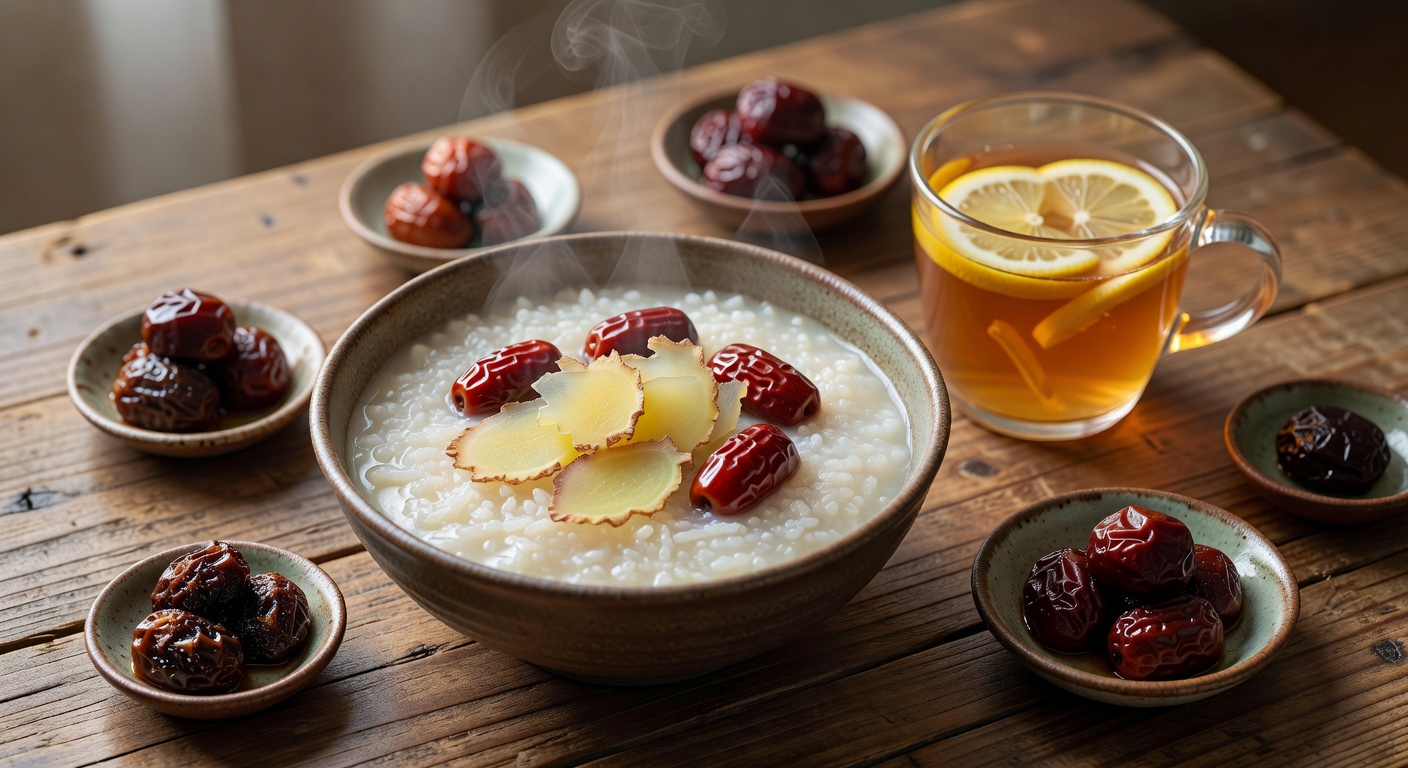
- Congee (粥): The single best food for a struggling Stomach. Plain rice congee is warm, easy to digest, and gently tonifies the Spleen. Add a few slices of fresh ginger while cooking for additional anti-nausea benefit. When you can tolerate more, stir in small amounts of chicken, dried scallop, or red dates.
- Ginger tea: Slice two to three thin pieces of fresh ginger into a cup of hot water. Sip slowly throughout the morning. Add a small amount of brown sugar if the taste is too sharp. Avoid ginger tea on a completely empty stomach if you have acid reflux tendencies.
- Lemon water: The sour flavour helps redirect Qi downward and cuts through the greasy, nauseous sensation. Squeeze half a lemon into room-temperature water. Avoid ice-cold lemon water, as cold constricts the Stomach and worsens Qi stagnation.
- Small, frequent meals: An empty stomach is a nauseous stomach. Eat small amounts every two to three hours rather than three large meals. Keep plain crackers, small rice balls, or dried biscuits by your bedside for when you wake up.
- Mildly sour foods: Preserved plums (话梅), sour green mango, and umeboshi (Japanese pickled plum) can temporarily ease nausea. In TCM, the sour flavour astringes and descends, counteracting the upward rebellion of Stomach Qi.
Foods to Avoid or Reduce
- Cold and raw foods: Ice cream, cold salads, chilled smoothies, and raw sashimi tax the Spleen and worsen Phlegm-Damp accumulation. In Singapore’s climate, it is tempting to reach for cold drinks, but your first-trimester Stomach will not thank you.
- Greasy and fried foods: Char kway teow, fried chicken, and heavy curries generate Dampness and heat, both of which intensify nausea. This is not forever. It is just while your body adjusts.
- Strong-smelling foods: Durian, petai, and heavily spiced dishes can trigger nausea before you even take a bite. If the hawker centre is unbearable, eat at home where you can control the environment.
- Excessive sweet foods: Sugar generates Dampness and weakens the Spleen. Bubble tea, kaya toast piled with sugar, and sweet desserts may provide momentary comfort but often make nausea worse within the hour.
Lifestyle Adjustments That Actually Help
Beyond herbs and food, TCM emphasises lifestyle adjustments during the first trimester that directly address the Qi disruption causing your symptoms:
- Rest without guilt: The first trimester is the most energetically demanding phase of pregnancy in TCM terms. Your body is building a placenta, redirecting Blood and Qi, and maintaining a developing embryo. Fatigue is not laziness. Adequate sleep (aim for eight hours minimum) supports Spleen and Kidney Qi, both of which reduce nausea severity.
- Gentle movement over intense exercise: Light walking, prenatal yoga, or qi gong promotes smooth Qi circulation without depleting your reserves. Avoid high-intensity workouts that drain Qi and generate internal heat. A 20-minute walk after meals can significantly improve digestion and reduce post-meal nausea.
- Manage stress proactively: Liver Qi stagnation from stress directly worsens morning sickness by invading the Stomach. Identify what is adding unnecessary pressure and address it where possible. Delegate work tasks, say no to non-essential social commitments, and communicate your needs clearly to your partner and family.
- Keep your abdomen warm: In TCM, cold in the uterus and lower abdomen disrupts Qi flow and can worsen nausea. Avoid sitting directly on cold surfaces, reduce air-conditioning exposure to the abdomen, and consider wearing a light belly band or placing a warm (not hot) compress on your stomach area when nausea peaks.
When to Seek Help Beyond TCM
TCM is effective for managing typical first-trimester nausea, but there are situations where you need Western medical attention immediately:
- You cannot keep any food or fluids down for more than 24 hours
- You are losing weight rapidly (more than 2 to 3 kg in a week)
- Your urine is very dark or you are urinating infrequently
- You feel dizzy, faint, or have a rapid heartbeat
- You have a fever along with vomiting
These may be signs of hyperemesis gravidarum or dehydration, both of which require medical intervention. TCM and Western medicine are not competing teams. Use both. See your obstetrician for the acute medical management and your TCM physician for ongoing constitutional support and recovery.
What a First Trimester TCM Treatment Plan Looks Like
If you visit a TCM clinic for morning sickness relief, here is a realistic picture of what to expect:
Initial consultation: Your physician will assess your pulse, examine your tongue, and ask detailed questions about your nausea patterns, digestion, energy levels, emotional state, and pregnancy history. This takes 20 to 30 minutes.
Treatment frequency: Most physicians recommend weekly acupuncture sessions during the worst of the nausea (typically weeks 7 to 12), tapering to fortnightly as symptoms improve. Herbal prescriptions are usually dispensed weekly and adjusted at each visit based on your response.
Expected timeline: Most women notice some improvement within the first one to two sessions, though complete resolution depends on severity and underlying constitution. Mild nausea may resolve in two to three weeks of treatment. More severe cases may require consistent treatment through the end of the first trimester.
Integration with prenatal care: Your TCM physician should be informed about your obstetrician’s care plan, any supplements you are taking (including folic acid and prenatal vitamins), and any medications prescribed. Similarly, let your obstetrician know you are receiving TCM pregnancy support. Transparency between both care providers gives you the safest and most effective outcome.
The first trimester is temporary. It does not feel that way at week 9 when you are dry-retching over the toilet for the third time before lunch, but it passes. TCM does not promise to eliminate every wave of nausea, but it can reduce the intensity, shorten the duration, and give your body the support it needs to get through the hardest stretch of early pregnancy with less suffering and better nourishment for both you and the baby growing inside you.
If morning sickness is making your first trimester harder than it needs to be, speak to our TCM physicians about pregnancy support. Relief starts with understanding your body’s specific pattern.