



As your due date comes closer, it is normal to wonder whether your body will be ready for labour, or to feel a flutter of worry when your gynae says your baby is breech. Take a breath: you have time and you have options. In the final weeks, TCM for labour preparation offers gentle, drug-free support to help your body get ready, ease late-pregnancy aches, and calm your nerves. For a breech or awkwardly positioned baby, there are traditional approaches some mums try too. None of this replaces your medical team, but it can sit comfortably alongside it. For the bigger picture, see our pregnancy care guide.
What “labour preparation” means in TCM
From around week 34 onwards, the focus of TCM care shifts from easing daily discomfort to getting you ready for the big day. It is not about rushing labour. It is about helping your body feel balanced, rested, and as prepared as it can be. In practice, late-pregnancy TCM usually means a mix of these:
- Pre-birth acupuncture: a short course of sessions in the final weeks, using thin needles at gentle points.
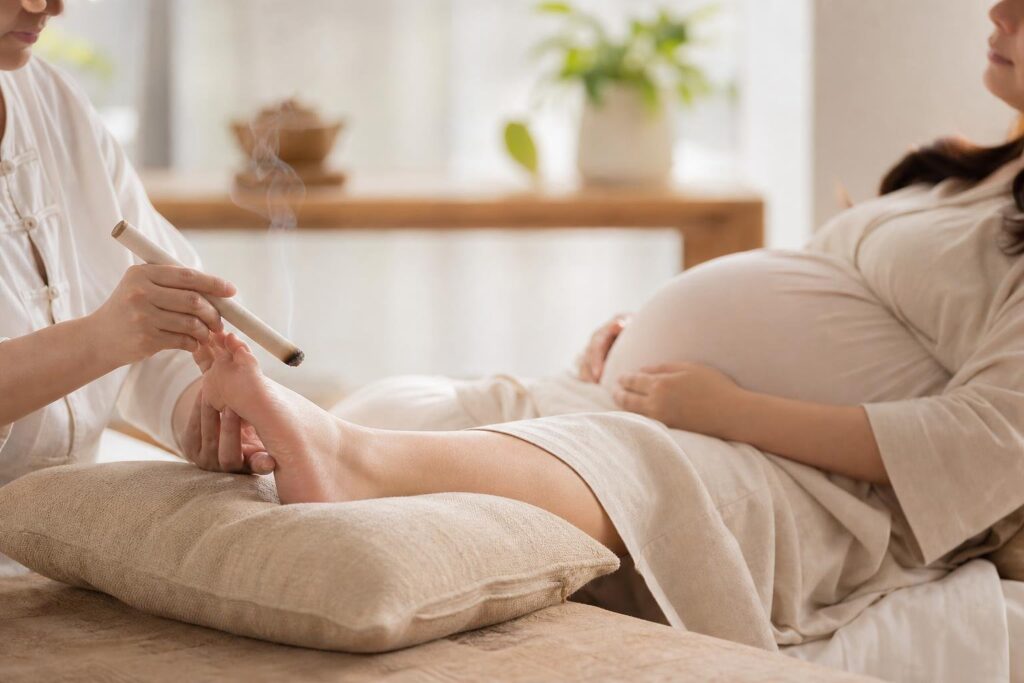
- Moxibustion for a breech baby: warming a point on the little toe with a smouldering herb stick, usually tried around weeks 34 to 36.
- Positioning advice: simple posture and movement tips to encourage your baby into a good position.
- Comfort care: gentle treatment for the lower back, hips, and pelvis as the bump gets heavy.
- Calming support: relaxing sessions and advice to help with sleep and pre-birth nerves.
Every mum is different, so a good physician tailors all of this to your stage, your body, and what your obstetrician (your pregnancy doctor) has advised. Nothing should ever be done against medical guidance.
Why mums turn to TCM near the end
The last stretch of pregnancy can be uncomfortable and a little nerve-wracking. Sleep gets harder, the bump feels heavy, and many mums feel anxious about how labour will go. TCM appeals because it is gentle and drug-free, and because it gives you something calming and practical to do while you wait. Many mums enjoy lying down for half an hour of quiet care at a stressful time.

Pre-birth acupuncture in the final weeks
Pre-birth acupuncture is a short course of acupuncture, usually one session a week, started from around week 36 or 37. Acupuncture means placing very fine needles at chosen points on the body. The needles are far thinner than injection needles, so most mums feel only a tiny prick, then a heavy or tingling feeling that is often relaxing.
The idea behind pre-birth acupuncture is to help your body get ready for labour rather than to start it. Mums who try it often say it helps them feel calmer and more rested in the final stretch. Be honest about the evidence: research is mixed, so think of pre-birth acupuncture as supportive care, not a guarantee of a faster or easier labour.
What a session feels like
A pre-birth session is relaxed. You rest, usually on your side or propped up rather than flat on your back, while the needles stay in for around 20 to 30 minutes. Many mums close their eyes and unwind. Your physician will always ask how many weeks along you are and check in with how you are feeling before starting. If anything feels uncomfortable, you simply say so.
When to start and what to expect
Most physicians begin pre-birth acupuncture from about week 36, building up to your due date. Certain acupuncture points are traditionally kept for full-term only, because they are considered more stimulating, which is exactly why this should be done by a trained physician and never copied at home. Set sensible expectations: this is calming, preparatory care, and your labour will still unfold in its own time and under your medical team’s care.
Breech and awkward positioning, explained simply
By the last weeks, most babies settle head down, ready to be born. Some do not, and that is what positioning talk is about.
- Breech means the baby is bottom or feet down instead of head down.
- Posterior means the baby is head down but facing your tummy rather than your spine, which some mums find leads to more back labour.
- Transverse means the baby is lying sideways.
Many babies are still moving around at this stage and will turn on their own, so an awkward position earlier on is not a reason to panic. Your gynae keeps an eye on your baby’s position at your check-ups, and if your baby stays breech near term, your doctor will talk you through the options.
What the medical options are
It helps to know the main paths your doctor may discuss, so TCM care can sit sensibly around them:
- ECV, a hospital procedure where a doctor tries to turn the baby by gently pressing on your tummy, usually offered around week 37.
- A planned C-section if the baby stays breech and that is the safer choice for you.
- A vaginal breech birth in some cases, depending on your situation and your hospital.
Which path is right is a medical decision you and your doctor make together. TCM does not change that. What it can offer is a gentle, traditional approach to try alongside, if your doctor is happy for you to.
Moxibustion for a breech baby
The best-known TCM approach for a breech baby is moxibustion, which means the gentle warming of a point with a smouldering mugwort herb stick held close to the skin. If your baby is still bottom-down in the final weeks, our TCM breech positioning support (from week 33) is built around this approach. For breech, the point used is at the outer corner of the little toenail, on both feet. The stick is never placed on the skin; it simply warms the area, giving a pleasant heat. Sessions are usually tried around weeks 34 to 36, often daily for a week or two, with your physician, who will only teach home use once they are confident it is safe for you to continue independently.
Mums understandably want to know if it works. The honest answer is that some studies suggest moxibustion may help encourage a breech baby to turn, but the evidence is not strong and it is far from guaranteed. It may help; it may not. It will never override what your scans show or what your doctor decides. Think of it as a gentle thing to try, not a fix.
Why this is not a DIY job
Moxibustion involves a lit, smouldering herb stick, so there is a real risk of burns and smoke if it is done carelessly. The timing, the point, and the technique all matter. Please do not buy a moxa stick online and try it alone from a video. If you would like to try moxibustion, see a qualified physician first. They will confirm it is suitable for you, coordinate with your obstetrician, and only teach home use if it is safe and you are comfortable.
Helping your baby into a good position
Alongside any treatment, simple daily habits may give your baby more room to settle head down. These are gentle, common-sense ideas, not guarantees, and they suit optimal foetal positioning, the term for encouraging a good birth position:
- Mind your posture: sit upright with your knees a little lower than your hips, rather than slouching back on a soft sofa.
- Stay gently active: short walks and easy movement, as your doctor allows.
- Lean forward when you rest: leaning over a birth ball or cushions can feel comfortable and open.
- Swim or do gentle stretches if your pregnancy is low-risk and your doctor agrees.
Treating late-pregnancy aches helps too, because a sore, tight lower back and pelvis make everything harder. Our pregnancy pain management service focuses on exactly this, and gentle prenatal massage can ease the load as your bump grows. If you are curious how massage adapts late on, our guide to prenatal massage by trimester explains what changes and when.
Working with your obstetrician, and red flags
This is the most important part. Late-pregnancy TCM is a supportive add-on; it never replaces your antenatal care. Keep every check-up, scan, and appointment, and follow your doctor’s advice. Tell your TCM physician your due date and anything your doctor has said, and tell your doctor about any TCM you are having. When both teams are in the loop, your care stays joined up and safe.
Some signs need urgent medical attention, not a TCM session. Go to your hospital or call your doctor straight away if you notice:
- Your baby moving much less than usual, or a change in the pattern.
- Your waters breaking or any sudden gush or trickle of fluid.
- Any vaginal bleeding.
- Regular or painful contractions before term.
- A bad headache, vision changes, or sudden swelling.
- A high fever or feeling very unwell.
When in doubt, get checked. No traditional approach is worth delaying medical care.
Frequently asked questions
Does moxibustion really turn a breech baby?
It might help, but it is not guaranteed. Some studies suggest moxibustion may encourage a breech baby to turn, while the overall evidence is gentle and mixed. It will never override your scans, and the decision on a breech birth, ECV, or C-section is always your doctor’s.
When should I start TCM for labour preparation?
Pre-birth acupuncture usually starts around week 36, and moxibustion for breech is often tried around weeks 34 to 36. Your physician will confirm the right timing for you and check it fits with your doctor’s plan.
Is acupuncture safe this late in pregnancy?
For most mums, yes, when it is done by a trained physician who uses the right points for your stage. Some points are kept for full-term only, which is why this is not a DIY treatment. Always say how many weeks along you are.
Can I do moxibustion at home?
Only if a qualified physician has assessed you and taught you safely, because a smouldering herb stick can cause burns. Never start it on your own from an online video. See a physician first so it can be coordinated with your obstetrician.
Will pre-birth acupuncture bring on labour or make it faster?
Think of it as calming, preparatory care rather than a way to start or speed up labour. The evidence is gentle, and your labour will still happen in its own time and under your medical team’s care.
Is it too late if my baby is still breech at 37 weeks?
Not necessarily. Some babies still turn, and your doctor may offer an ECV or talk through birth options. TCM can be tried alongside if your doctor agrees, but the medical plan always comes first.
Feeling more prepared, and supported, in your final weeks matters. If you would like gentle, professional help getting ready for labour, explore our pregnancy care options and speak to a physician who looks after mums-to-be every day, in step with your medical team.